SLP and OT Students Collaborate to Explore a Holistic Approach of Care
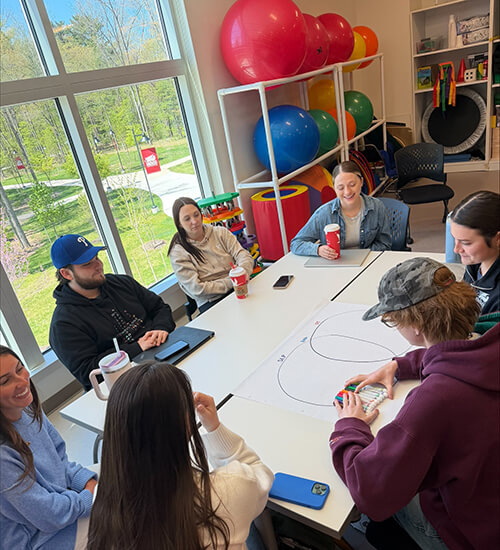 GMercyU’s Master of Science in Speech-Language Pathology and Master of Science in Occupational Therapy students learned how interdisciplinary collaboration can improve client care through a holistic approach during an interactive session this week.
Students worked in small groups to examine similarities and differences between the roles of occupational therapists and speech-language pathologists – for example, how each profession handles feeding issues.
“SLPs focus on oral motor skills and the swallowing components of feeding, while we address the fine motor skills required for accessing feeding utensils, sensory processing outside and within the mouth, and oral motor skills required for eating,” said one MSOT student.
Students collaborated on a case study, combining perspectives from both disciplines to identify a client’s strengths and areas of need.
“MSSLP students contributed strategies to support communication and feeding, while MSOT students focused on the client’s occupational needs,” Assistant Professor Jennifer McIlvaine O'Donnell, Ph.D., CCC-SLP/L, ATP said.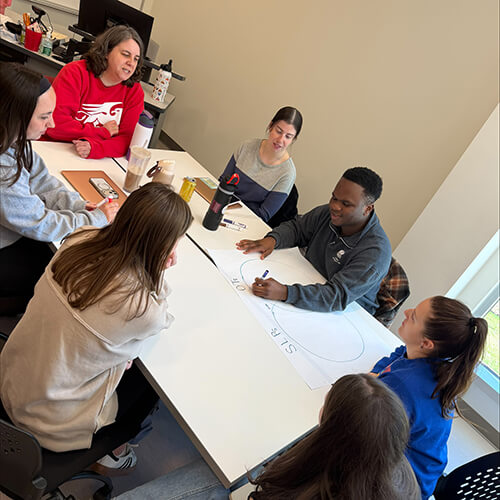
Students then reconvened as a group to discuss priorities for intervention based on the needs of the client and family. They also identified meaningful daily routines (e.g., mealtime, bedtime), where strategies from both disciplines could be effectively integrated.
Students enjoyed learning about each other’s professions and how they could work together to accomplish multiple goals. For example, an MSSLP student got advice from an MSOT student about a client at her clinical on their positioning during therapy.
Just as helpful, they learned what they wouldn’t collaborate on professionally, too. “It will be easier to refer a client to OT now that I know what is in their scope of practice,” said one MSSLP student.
Additional Student Thoughts on the Session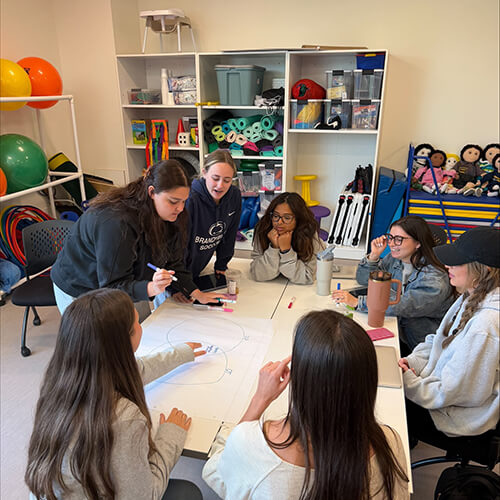
"One new thing I learned from our collaboration is that speech-language pathologists do more than just work on speech. They also focus on how clients understand and process language so they can participate in everyday activities. I also learned about something called the Big 9, which is kind of similar to the 9 areas we use in OT. I thought that was really interesting because it showed how both professions use different frameworks to guide what they do."
"I was able to learn more about the specifics of what OT does and how it goes hand-in-hand with speech pathology. I was able to learn more terminology surrounding their field and other domains they work with."
"One new piece of information I learned was that SLPs don't just focus on speech and language, they also play a role in cognition, attention, memory, and problem-solving. I thought this was interesting because it didn't realize it was a part of their scope."